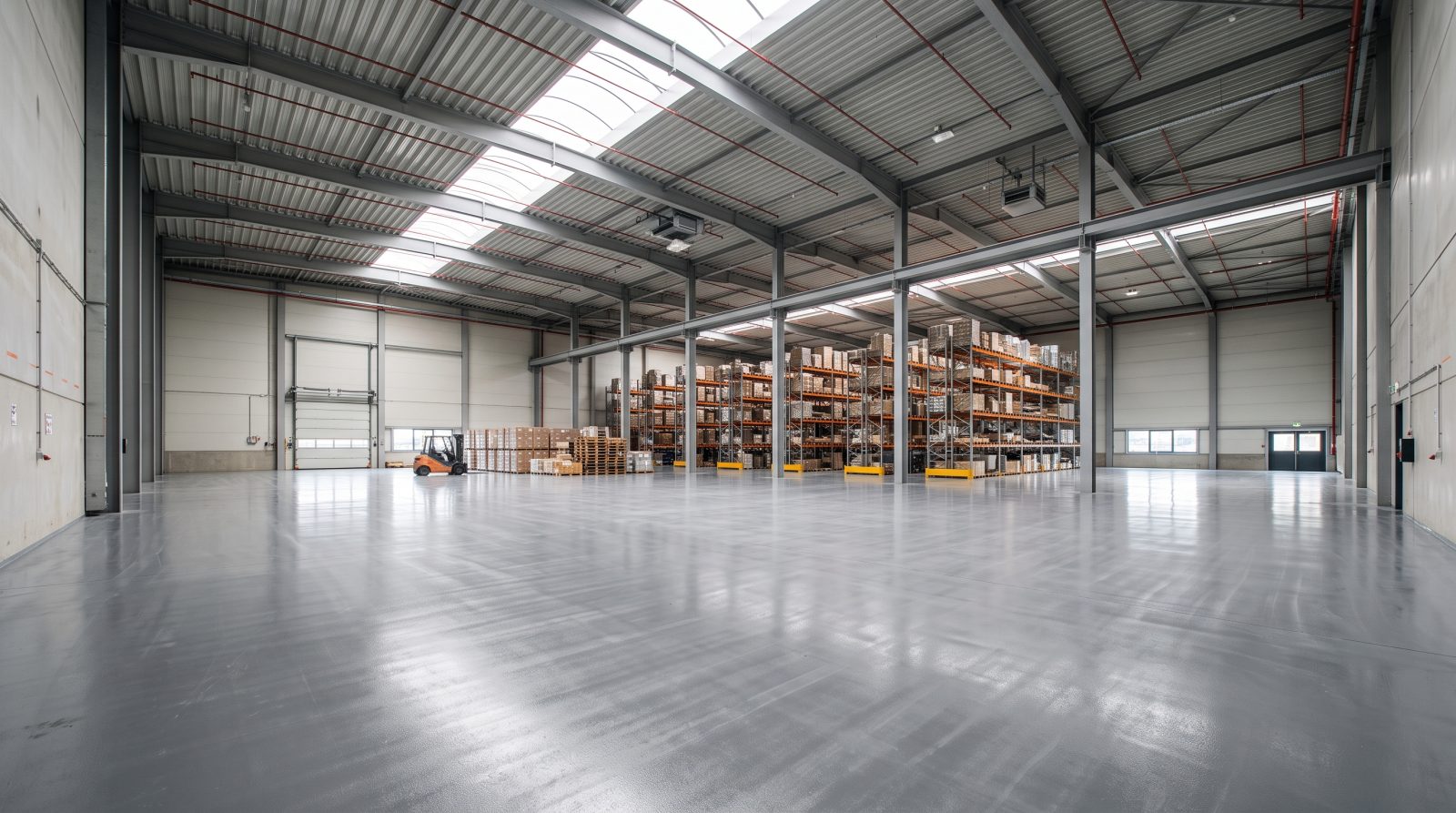
Why warehouse and industrial floors need more than paint
Bare concrete in a warehouse is porous, dusty, and slowly grinding itself apart. Every forklift wheel, every dropped pallet, and every spilled solvent works into the surface. "Floor paint" from a big-box store sits on top of that surface and tends to peel within months under industrial traffic, because it isn't a true epoxy and isn't bonded into a properly prepared slab. A real industrial epoxy system is different: it's a two-part thermoset resin that chemically cures into a hard, dense film mechanically keyed into the concrete.
The practical payoff is dust control, chemical and abrasion resistance, and a surface that's far easier to sweep, scrub, and inspect. A sealed floor doesn't shed concrete dust into your inventory, your machinery, or your air handling. It also reflects overhead light, which can meaningfully brighten a warehouse without adding fixtures. For facilities working toward a cleaner audit or a safer floor, that combination of durability and cleanability is usually the whole reason to coat.
- Stops concrete dusting that contaminates product, racking, and HVAC
- Resists forklift and pallet-jack traffic, point loads, and impact
- Withstands oils, solvents, coolants, and many process chemicals (system-dependent)
- Seamless, non-porous surface that's easy to clean and inspect
- Brightens the space by reflecting existing light
Which epoxy system fits your facility?
The right buildup depends almost entirely on the punishment the floor takes. We scope every job by traffic type, load, chemical exposure, and how much downtime you can spare. As a rule of thumb, the heavier the use, the thicker and more aggressive the system.
Roller-applied epoxy in the 20-to-40-mil range suits lighter warehouse and storage areas with foot traffic and occasional carts. High-build epoxy around 40-to-125 mils handles steady forklift and pallet-jack traffic in most distribution and storage operations. For the harshest zones, an epoxy mortar or troweled-down system at 1/8 inch to 1/4 inch (roughly 125-to-250 mils) takes heavy impact, dragged steel, and hot-traffic areas. Where chemical or thermal-shock resistance is critical, we'll specify a different resin chemistry rather than just adding thickness.
Topcoat chemistry matters as much as thickness. A polyaspartic or urethane topcoat over an epoxy base adds UV stability, faster return-to-service, and stronger chemical and abrasion resistance for the wear layer. We commonly broadcast aluminum oxide or silica into the topcoat to hit a target slip resistance, which is the safe way to add traction in wet or oily zones.
- Light-duty storage/foot traffic: ~20-40 mil roller-applied epoxy
- General warehouse & forklift traffic: ~40-125 mil high-build epoxy
- Heavy impact / mortar zones: 1/8"-1/4" troweled epoxy mortar
- Wet, oily, or chemical zones: chemical-resistant resin + slip-resistant broadcast
- UV-exposed or fast-turnaround areas: polyaspartic/urethane topcoat
Surface prep: where the job is won or lost
The single biggest reason industrial coatings fail is bad preparation, not bad product. Epoxy is only as good as its bond to the concrete, and that bond is created mechanically before any resin is poured. We don't acid-etch industrial floors; we mechanically profile them. Diamond grinding or shot-blasting opens the surface to a measurable concrete surface profile (typically CSP 2-4 for these systems) so the resin can lock in.
Before grinding, we test the slab. A calcium chloride or in-situ relative-humidity test tells us whether moisture vapor is moving up through the slab, which is common in older South Bay tilt-ups and slabs poured without a vapor barrier. If moisture is high, we install a moisture-mitigation primer first; skip that step and even a perfect topcoat is likely to blister and delaminate. We also chase and fill cracks, joints, spalls, and old anchor holes, and grind out previous failing coatings so we're building on sound concrete.
- Mechanical profiling (diamond grind or shot-blast), not acid etching
- Moisture testing (calcium chloride / RH probe) before coating
- Moisture-mitigation primer where vapor transmission is high
- Crack, joint, and spall repair plus removal of failing old coatings
- Target concrete surface profile (commonly CSP 2-4) for a real mechanical bond
Cure times, downtime, and keeping production moving
For an operating facility, the schedule is as important as the finish. Standard epoxy typically needs about 12-24 hours before light foot traffic, and a full chemical and mechanical cure that can carry forklifts and heavy loads usually lands around 5-7 days at normal temperatures. Those numbers stretch in cold conditions and shorten with heat, so ambient and slab temperature drive the timeline.
When downtime is tight, we can specify polyaspartic or fast-cure systems that return foot traffic in hours and vehicle traffic the next day, at a higher material cost. We also phase the work zone by zone, run off-shift and weekend installs, and keep aisles open so receiving and shipping don't stop. One non-negotiable: epoxy is temperature- and humidity-sensitive during application. We generally hold the slab above roughly 50-55F and stay clear of the dew point, because coating a cold or sweating slab almost always fails.
- Light foot traffic: typically ~12-24 hours after final coat
- Full load/forklift-ready cure: typically ~5-7 days at standard temps
- Fast-cure/polyaspartic options for next-day vehicle return
- Phased, off-shift, and weekend installs to protect production
- Application held in a controlled temp/humidity window, away from dew point
Safety, line striping, and compliance details
An industrial floor isn't just a coating; it's part of how your facility runs safely. We broadcast anti-slip aggregate to a chosen grit so traction matches the environment, finer in clean dry zones, more aggressive near wash-down areas, ramps, and loading docks. Slip resistance is something you specify on purpose, not an afterthought.
We also lay down OSHA-style safety markings and traffic management directly into or onto the coating: aisle lines, pedestrian walkways, forklift lanes, hazard striping, and floor-marked staging or do-not-stack zones. Color-coding the floor is one of the cheapest ways to reduce near-misses in a busy warehouse. For wash-down or chemical-process areas we can integrate cove base at wall-to-floor transitions so there's no seam for water and contaminants to hide in, which matters for sanitation in the food, beverage, and lab settings common around the South Bay.
- Slip-resistant broadcast tuned to each zone (dry vs. wet/oily)
- Aisle, pedestrian, forklift-lane, and hazard floor markings
- Color-coded staging and keep-clear zones to cut near-misses
- Integral cove base for wash-down and sanitation areas
- Coatings selected for the chemicals your process actually uses
What it typically costs (industry-range estimate, not a quote)
Pricing is driven by system thickness, slab condition, and how much prep and downtime the job requires, so the only accurate number is one written for your floor after we see it. As a general industry guide, a standard high-build warehouse epoxy commonly runs in the range of roughly $4-$9 per square foot installed, while heavier mortar systems, extensive moisture mitigation, or significant concrete repair can push well above that. These are typical ranges, not a set price.
The biggest swing factor is almost always the concrete itself. A clean, sound, dry slab coats efficiently. A slab with high moisture vapor, failing old coatings, oil-saturated zones, or widespread cracking needs remediation first, and that work is what moves a number. We put all of it in writing, line-itemed, so you can see exactly what's prep, what's coating, and what's optional. To scope your facility, give us a call and we'll walk the floor, test the slab, and put real numbers to your square footage.
- Standard high-build warehouse epoxy: roughly $4-$9/sq ft installed (typical range)
- Mortar systems, moisture mitigation, and heavy repair cost more
- Slab condition is the main cost driver, not square footage alone
- Every estimate is line-itemed: prep vs. coating vs. options
- Ranges are industry estimates only, not a set price