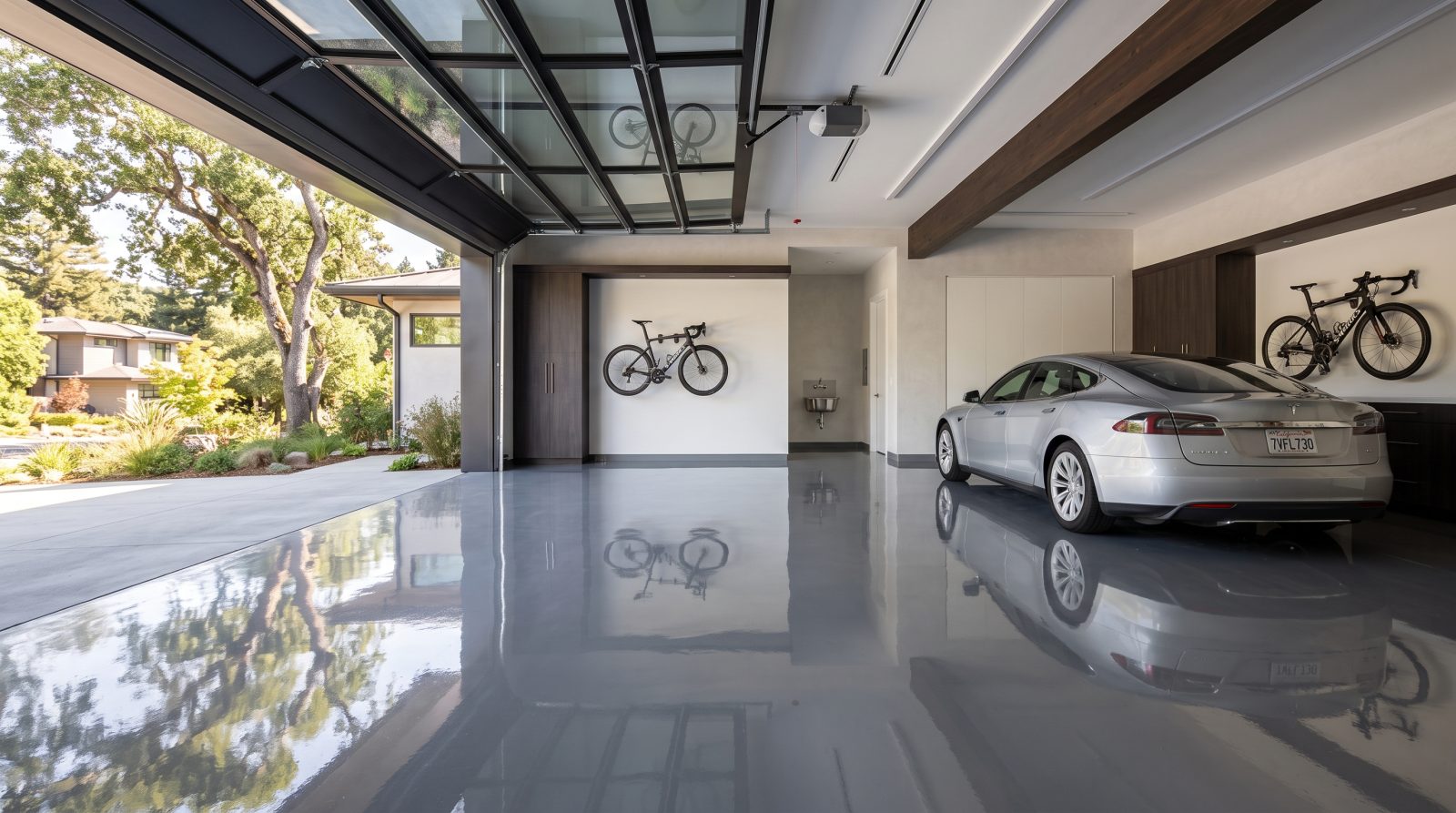
Why epoxy and concrete coatings make sense for Cupertino homes
Cupertino's housing stock leans toward mid-century ranch homes, Eichler-style flat-roof builds, and a growing share of newer construction, and nearly all of them share one feature: an attached or detached garage on a poured concrete slab. Bare slab is porous. It soaks up motor oil, brake fluid, and the fine grit tracked in from driveways, and over the years that staining becomes permanent. A bonded coating turns that porous surface into a sealed, wipeable one.
The local climate generally works in your favor. Cupertino follows a Mediterranean pattern: warm, dry summers and cool, wet winters, with relatively low humidity for much of the year. Coatings cure by chemical reaction, and stable, moderate temperatures make it easier to stay inside the manufacturer's recommended application window without the swings you would fight in a humid or freezing region. In practice that often means cleaner results and fewer weather-related delays than in many parts of the country.
Beyond garages, the same family of products protects patios, pool decks, basement and storage-room floors, and small home workshops. The right choice depends on how the space is used and how much sun it gets, which the next sections break down.
How Cupertino's soil and slabs affect a coating job
The biggest factor in a long-lasting coating around here is not the climate above the slab; it is the ground beneath it. Much of the Santa Clara Valley, Cupertino included, sits on expansive clay soils that swell when wet and shrink when dry. Across a wet winter and a dry summer, that movement can stress a slab and open hairline cracks. Older slabs, and slabs poured without a vapor barrier, can also wick ground moisture up through the concrete.
This matters because coatings tend to fail from underneath far more often than from on top. If moisture is pushing up through the slab, even a high-quality epoxy can blister or peel. That is why a sound assessment starts with a calcium chloride or relative-humidity moisture test and a close look at existing cracks, rather than a sales pitch about gloss levels.
For a typical Cupertino slab, that translates to a few practical steps: existing cracks should be cut, cleaned, and filled before coating; high-moisture slabs may need a moisture-mitigating primer; and on older garages, some grinding is usually needed to remove prior sealers or paint. None of this is exotic, but skipping it is the most common reason a low-bid coating lifts within a year or two.
Which coating system fits your space?
There is no single best coating, only the best fit for how a floor is used and how much sun and traffic it sees. Here is how the main options compare for typical Cupertino spaces.
- Polyaspartic / polyurea systems: Fast-curing and highly UV-stable, so they hold their color in sun-exposed spots and often allow a quicker return to use. A strong pick for garages and any area that gets direct light.
- Epoxy with a polyaspartic or urethane topcoat: A thick, durable epoxy base for chemical and abrasion resistance, finished with a UV-stable topcoat so it resists ambering (yellowing) over time. A common premium garage build.
- Flake (decorative chip) broadcast: Vinyl flakes broadcast into the coating add traction and hide minor slab imperfections. Popular for garages and patios where a little texture underfoot is welcome.
- Solid-color or metallic epoxy: A smooth, high-gloss look for showroom-style garages or interior spaces. Striking, but smoother finishes can be slick when wet, so weigh that for any area that sees moisture.
- Concrete densifier and sealer: For owners who want stain and dust resistance without a full color coating, penetrating sealers harden and seal the slab while keeping a natural concrete look.
What the installation process looks like
A quality coating is mostly preparation. The visible color goes down quickly; the days beforehand are what determine whether the floor lasts. Here is the typical sequence for a residential garage or patio.
Surface prep comes first. Diamond grinding or shot blasting opens the concrete's pores so the coating can bond mechanically, and oil stains are degreased and treated. Cracks and pitting are then repaired and the slab is vacuumed clean. Prep is the step budget operators tend to cut, and it is the step that matters most.
Next is priming and moisture control. A primer goes down (a moisture-mitigating one where testing calls for it), followed by the base coat. If a flake finish is chosen, the chips are broadcast into the wet base. Finally, a clear topcoat seals everything and sets the gloss and slip level.
Timing varies by system. With fast-cure polyaspartic builds, many garages are walkable in roughly a day and ready for vehicle traffic within a few days, while traditional epoxy builds usually need a longer cure before you drive on them. Exact return-to-service times depend on the product, the number of coats, and slab temperature, so your installer should give you specific numbers for your job rather than a flat promise.
Typical cost ranges in the Cupertino area
The figures below are typical industry ranges for planning purposes, not quotes. Your actual price depends on slab size and condition, how much prep and crack repair is needed, the coating system, and the number of coats. The only way to get a real number is an on-site assessment.
As a general guide, a basic single-coat or sealer treatment on a clean slab sits at the lower end, a mid-range flake epoxy garage system is the most common residential choice, and premium polyaspartic builds with heavy prep or moisture mitigation run higher. Larger slabs usually cost less per square foot than small ones, because mobilization and prep are spread over more area.
Bay Area labor, plus the extra prep that older or moisture-affected Cupertino slabs often need, can push a job toward the upper part of any published range, so treat low online averages with caution. A clear written scope that spells out prep, repairs, coats, and warranty terms is the best protection against surprises.
- Penetrating sealer / densifier (natural concrete look): lower end of the range, minimal prep
- Flake (chip) epoxy garage system: the most common mid-range residential option
- Polyaspartic / polyurea or epoxy-with-UV-topcoat builds: higher end, fastest return to use
- Add-ons that raise cost: extensive crack repair, oil-stain remediation, old-coating removal, and moisture-mitigating primer