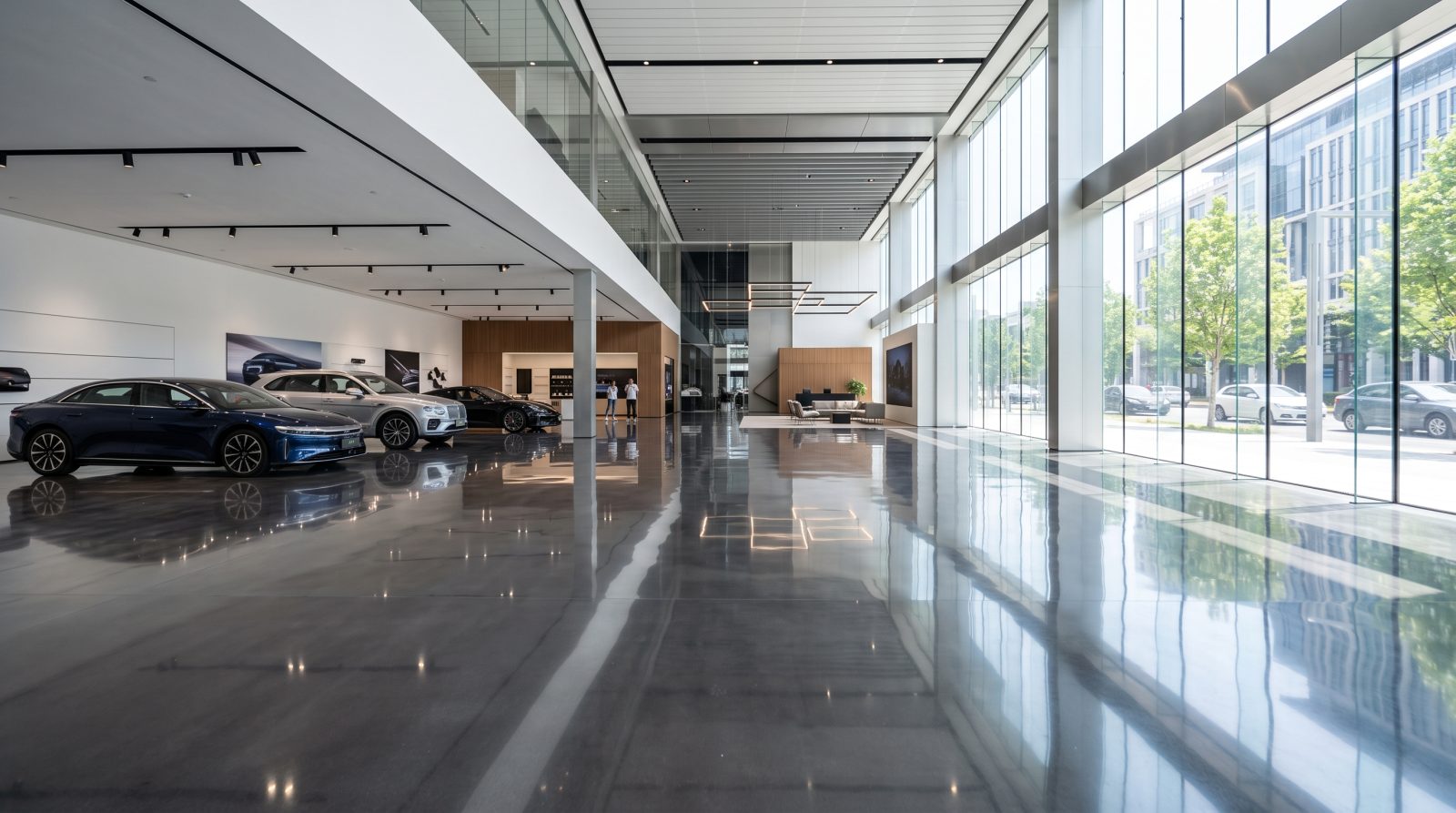
What is commercial epoxy flooring, and how is it different from a garage coating?
Commercial epoxy flooring uses the same core chemistry as a residential garage floor, two-part resin and hardener that cure into a hard, bonded film, but the systems are specified for heavier demands. A commercial slab usually sees forklifts, pallet jacks, rolling carts, constant foot traffic, dropped tools, hot tires, and frequent cleaning, so the build is thicker, the topcoats are tougher, and the prep is more aggressive than a typical home garage.
The term covers a range of products. Thin-film epoxy coatings (roughly 6 to 20 mils) work well for light-to-moderate traffic like back offices, retail floors, and storage rooms. Self-leveling epoxy mortar systems (often 1/16 to 1/4 inch) are used where the slab is uneven or impact resistance matters. Polyaspartic and polyurea topcoats are frequently layered over an epoxy base in spaces that can't close for long, because they cure fast and resist UV yellowing better than straight epoxy.
What ties all of these together is the result: a seamless, non-porous surface with no grout lines or tile seams to trap dirt, grease, or bacteria. That is why epoxy and its cousins are common in environments where cleanliness, durability, and traction all matter at once.
- Seamless and non-porous, so spills wipe up instead of soaking into bare concrete
- Chemical and abrasion resistant, holding up to oils, solvents, and forklift wheels
- Customizable traction with broadcast aggregate or anti-slip additives in the topcoat
- Bright, reflective finishes that lift facility lighting and improve visibility
Which businesses and surfaces is commercial epoxy flooring best for?
Epoxy and polyaspartic systems are a strong fit anywhere a concrete slab takes abuse and needs to stay clean. In the South Bay's mix of light-industrial parks, auto and fleet shops, food and beverage producers, and ground-floor retail, the most common applications fall into a handful of clear categories, each with its own system requirements.
Matching the system to the use is what keeps a floor from failing early. A warehouse needs impact and abrasion resistance under wheel loads; a commercial kitchen needs a slip-resistant, cove-based system that can survive hot water and grease; a showroom prioritizes a flawless, high-gloss finish. The same product is rarely ideal for all three.
- Warehouses and distribution: high-build epoxy with line striping for forklift lanes and safety zones
- Auto, fleet, and equipment shops: oil- and solvent-resistant coatings with anti-slip topcoats
- Commercial kitchens, breweries, and food prep: cove-base, slip-resistant systems built for hot-water washdowns
- Retail, showrooms, and lobbies: decorative flake or metallic finishes with a high-gloss clear coat
- Healthcare, labs, and clean spaces: seamless, easy-to-sanitize coatings with controlled traction
- Manufacturing and assembly: chemical-resistant systems with designated walkways and ESD options where needed
Why does surface prep decide whether a commercial floor lasts?
Coating failure is almost always a bonding failure, and bonding is established during prep, before any resin is mixed. Epoxy adheres mechanically to the concrete profile, so the slab has to be opened up and cleaned so the coating can grip. The most reliable method for commercial work is diamond grinding or shot blasting to create a concrete surface profile (commonly CSP 2 to 4, depending on the system). Acid etching alone is generally not enough for a heavy-traffic commercial floor.
Moisture is the other make-or-break factor, and it matters in any region with seasonal humidity or slabs poured on grade without a vapor barrier. Concrete that is releasing too much moisture vapor will push a coating off the slab over time. Reputable installers test for this, often with a calcium chloride test or in-situ relative humidity probes, and use a moisture-mitigation primer when readings are high. Cracks, control joints, spalls, and oil-saturated areas are repaired and degreased before coating, because a coating only performs as well as the surface beneath it.
Concrete also has to be sound and reasonably cured. New slabs typically need to cure around 28 days before coating, and existing slabs are profiled and patched rather than simply cleaned. Skipping or shortcutting prep is the most common reason a cheap commercial floor peels within a year, which is why prep, not the coating brand, is the honest measure of a quality job.
- Diamond grind or shot blast to a proper concrete surface profile (often CSP 2 to 4)
- Test slab moisture and apply a mitigation primer when vapor readings are high
- Repair cracks, joints, spalls, and degrease oil-stained zones before coating
- Confirm new slabs are adequately cured (commonly around 28 days) before application
How is a commercial epoxy floor installed, step by step?
A professional commercial install follows a predictable sequence, and understanding it helps you plan around your operations. After an on-site assessment of the slab's condition, square footage, traffic, and chemical exposure, the installer profiles the concrete, repairs defects, and applies a primer keyed to the system and any moisture concerns. The base coat or self-leveling layer goes down next, followed by any decorative broadcast (color flake or quartz) and finally one or more protective topcoats.
Timing is driven by chemistry and conditions. Epoxy is temperature- and humidity-sensitive: most systems want a slab and ambient temperature roughly in the 50 to 90 degree Fahrenheit range, with relative humidity controlled and the slab held above the dew point so condensation doesn't ruin adhesion. Each coat needs a recoat window, and rushing it traps solvents or causes delamination.
Cure times are the part that affects your reopening schedule the most. As a general rule, standard epoxy is walkable in about 12 to 24 hours, ready for light foot traffic around 24 to 48 hours, and fully cured for heavy loads and forklifts in roughly 5 to 7 days. Polyaspartic and polyurea topcoats cure far faster, sometimes allowing foot traffic within hours and vehicle traffic within a day, which is why they are popular for facilities that cannot afford a long shutdown. These are typical ranges; the product data sheet and on-site temperature govern the actual numbers.
- Assess the slab, then grind or blast to profile and repair defects
- Prime, accounting for moisture, then apply base or self-leveling coat
- Broadcast decorative flake or quartz if specified, then seal with protective topcoat(s)
- Honor recoat windows and cure times; phase work to keep parts of the facility running
What does commercial epoxy flooring cost?
Commercial epoxy is almost always priced per square foot, and the range is wide because the system, slab condition, and prep requirements vary so much. As a typical industry estimate, a basic thin-film epoxy coating commonly falls around 3 to 7 dollars per square foot installed, a mid-range flake or higher-build system around 7 to 12 dollars, and heavy-duty or specialty systems (self-leveling mortar, urethane cement for kitchens, ESD, or extensive moisture mitigation) often 12 to 20 dollars or more. These are general ranges to help you budget, not a quote, and your actual price depends on your specific space.
The factors that move a commercial bid are mostly about the slab and the schedule, not just the product. A clean, sound, level slab costs far less to coat than one that needs crack repair, grinding of old coatings, oil remediation, or moisture mitigation. Square footage drives economies of scale, so larger jobs usually carry a lower per-foot rate. After-hours or phased work to keep a business running, decorative finishes, line striping, and cove base all add to the total.
An honest bid should spell out the system being used, the prep included, the number of coats, and the warranty terms, so you can compare proposals on equal footing. Be cautious of any quote that is dramatically lower than the rest, as it usually signals skipped prep, a thinner build, or acid etching in place of mechanical profiling. For a firm number, the only reliable path is an on-site assessment of your actual floor.
- Basic thin-film epoxy: roughly 3 to 7 dollars per square foot installed (typical estimate)
- Mid-range flake or high-build systems: roughly 7 to 12 dollars per square foot
- Heavy-duty, kitchen urethane, ESD, or moisture-mitigated systems: roughly 12 to 20+ dollars
- Price drivers: slab condition, square footage, prep scope, downtime requirements, and finish
How do you maintain a commercial epoxy floor so it lasts?
One of the biggest operational advantages of a seamless epoxy floor is how simple it is to keep clean. Because there are no grout lines or porous concrete to absorb spills, routine maintenance is mostly dust mopping and wet mopping with a pH-neutral cleaner. Most spills wipe up without staining, and washdown-rated systems can take a hose and squeegee where the floor was designed for it.
Longevity comes from protecting the topcoat. Grit acts like sandpaper under wheels, so regular sweeping in high-traffic and entry zones matters more than any single deep clean. Walk-off mats at doorways catch debris, and floor-protector pads or care under heavy point loads prevent gouging. Harsh, highly acidic or solvent-based cleaners can dull or degrade some coatings over time, so it is worth matching the cleaner to the system.
With routine care, a quality commercial floor typically performs well for 10 to 20 years before it needs attention, though the topcoat in heavy-traffic lanes may benefit from a refresh sooner. A periodic recoat of the wear layer is far cheaper than a full replacement and can extend the life of the original base for many years. Keeping a record of the exact system installed makes future recoats and color matching straightforward.
- Dust mop and wet mop with a pH-neutral cleaner; avoid harsh acids and strong solvents
- Sweep high-traffic lanes often, since grit is the main cause of topcoat wear
- Use walk-off mats and pads under heavy point loads to prevent gouging
- Plan a wear-layer recoat over the years rather than a full tear-out