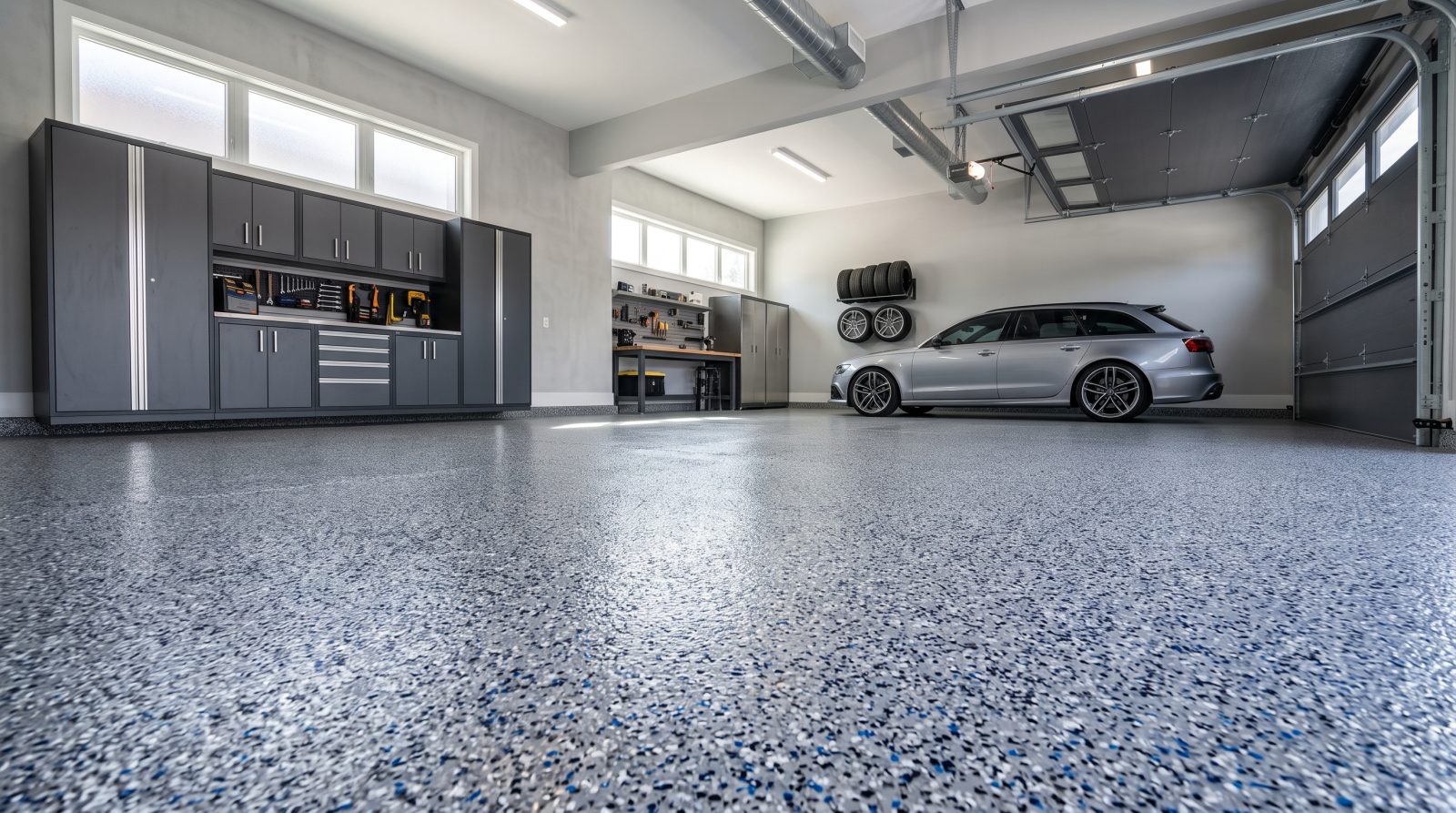
What is flake epoxy floor coating?
Flake epoxy (also called chip broadcast, decorative flake, or full-broadcast flake) is a layered floor system built directly on prepared concrete. The bottom layer is a pigmented epoxy basecoat. While that basecoat is still wet, colored vinyl flakes are hand-broadcast across the surface, usually to refusal (meaning so densely that no basecoat shows through). Once the basecoat cures, the excess loose flake is scraped and vacuumed up, the surface is lightly sanded smooth, and one or more clear topcoats are rolled on to lock everything in and create the finished wear surface.
The flakes themselves are typically colored PVC chips that come in blends combining two to five colors, in common sizes around 1/4 inch for a fine look or 1 inch for a bolder, more dimensional pattern. Because the chips are distributed across the whole floor, they camouflage small cracks, patches, and color variation in the original slab far better than a solid color. They also create a subtle texture that adds slip resistance underfoot.
It helps to think of flake epoxy as a system rather than a single product. The basecoat bonds to the concrete, the flake provides color and texture, and the clear topcoat (often a polyaspartic or polyurethane) does the heavy lifting for abrasion, chemical, and UV resistance. The quality and thickness of each layer, not just the brand on the bucket, is what determines how long the floor lasts.
How is a flake epoxy floor installed step by step?
A durable flake floor lives or dies on preparation. The single most important step is mechanically profiling the concrete, usually by diamond grinding or, on larger or denser slabs, shot blasting. This opens the pores of the concrete so the epoxy can grip. Coatings that fail and peel almost always trace back to skipped or shortcut prep, such as acid etching alone or coating over a sealer, oil, or moisture.
- Inspect and test: check the slab for moisture, oil staining, prior coatings, and cracks. A simple plastic-sheet or calcium chloride test flags moisture problems before they ruin a coating.
- Profile the concrete: diamond grind (or shot blast) to a CSP 2-3 profile so the epoxy can mechanically bond.
- Repair: fill cracks, spalls, and pits with an epoxy or polyurea patch, then re-grind those areas flush.
- Prime and base: apply the pigmented epoxy basecoat at the manufacturer's spec thickness.
- Broadcast flake: hand-cast the chips into the wet base, typically to refusal for full coverage.
- Scrape and vacuum: after cure, remove loose flake and lightly sand the surface smooth.
- Topcoat: roll one or two clear coats (polyaspartic or polyurethane) to seal and create the wear layer.
Why choose flake epoxy over a one-color floor?
A solid-color epoxy or a hardware-store epoxy paint can look great on day one, but it shows everything: tire marks, dust, scratches, and every patch in the slab. Flake floors are far more forgiving day to day because the multi-color pattern visually breaks up dirt and minor wear, so the floor looks clean longer between washings.
Durability is the bigger difference. A properly installed flake system is meaningfully thicker than a thin paint film and is sealed with a tougher topcoat, so it resists hot tire pickup (where soft, hot tires literally peel thin coatings off the floor), dropped tools, dragged furniture, and common garage chemicals like motor oil, brake fluid, and road salt. The flake texture also adds traction, which matters when a garage floor gets wet from rain runoff or a washed car.
Maintenance is simple, which is part of the appeal. A finished flake floor is seamless and non-porous, so spills wipe up instead of soaking in, and routine care is usually just a dust mop and an occasional damp mop with a pH-neutral cleaner. There are no grout lines or seams to trap grime the way tile or bare concrete does.
How does the South Bay climate affect epoxy installation?
The South Bay's mild, dry climate is genuinely good for epoxy. Most days fall in the moderate temperature and humidity range that coatings prefer, which makes for reliable cures and fewer weather-related delays than contractors face in humid or freezing regions. Epoxy basecoats generally want the slab and air above about 50 to 55 degrees Fahrenheit during application and cure, and our typical conditions sit comfortably above that for much of the year.
The factor that matters most here is slab moisture, not air temperature. Many South Bay garages and older homes have concrete slabs poured directly on grade, sometimes without a vapor barrier underneath, and seasonal groundwater or irrigation can push moisture up through the concrete. Moisture vapor that exceeds a coating's tolerance is the leading cause of bubbling and delamination, which is exactly why a moisture test before installation is non-negotiable. When a slab tests high, a moisture-mitigation primer is added to the system rather than gambling on the coating.
Concrete condition is the other local variable. Garages built across different decades range from smooth, power-troweled slabs that need aggressive grinding to open them up, to older, pitted, oil-stained floors that need crack repair and patching first. Hairline cracks from minor slab movement are common and are routinely repaired and bridged as part of prep, so they don't telegraph through the new floor.
What does a flake epoxy floor cost and how long does it last?
Pricing varies with the condition of your concrete and the system you choose, so the figures below are typical industry ranges for planning only, not a quote. For a standard residential flake epoxy garage floor, installed cost commonly lands somewhere in the range of about 4 to 8 dollars per square foot, which puts a typical two-car garage of roughly 400 to 500 square feet in the neighborhood of a few thousand dollars. Floors that need extensive crack repair, heavy oil removal, moisture mitigation, or premium polyaspartic topcoats sit toward the higher end. The only way to know your number is an on-site look at your specific slab.
On lifespan, a professionally installed flake system with proper prep and a quality topcoat typically holds up for many years of normal residential use, often well into the 10-to-20-year range, while thin DIY paint kits frequently start peeling within a year or two under cars. The single biggest predictor of how long any epoxy floor lasts is the preparation underneath it, followed by the durability of the topcoat. That is why we'd rather spend more time grinding and testing than rush the visible part.
When you compare quotes, compare systems, not just prices. Ask how the concrete is being profiled (diamond grinding or shot blasting versus acid etch only), whether a moisture test is included, the basecoat and topcoat thickness, and what topcoat is used. A low bid that skips profiling or uses a single thin coat is not the same product as a fully ground, full-broadcast, topcoated floor, even if both are called epoxy.
Is flake epoxy right for your space?
Flake epoxy is an excellent fit for residential garages, workshops, basements, mudrooms, laundry rooms, gyms, and patios or covered outdoor areas that get foot and vehicle traffic. It performs well anywhere you want a tough, easy-to-clean, attractive floor over concrete. For most homeowners deciding between a plain sealed slab, solid-color epoxy, and flake, the flake system is the sweet spot for looks and forgiveness.
There are cases where a different system makes more sense, and we'll tell you if so. Slabs with serious, ongoing moisture intrusion need mitigation first. Floors exposed to harsh, specific chemicals or very high heat may call for a specialized industrial coating. And freshly poured concrete needs to cure (commonly around 28 days) before it can be coated. Being honest about these situations up front is how a coating ends up lasting instead of failing.
If you're considering a flake epoxy floor for a garage or concrete space in the South Bay, the best next step is a look at your actual slab so any moisture, cracks, or prior coatings are caught before work begins. Call us to talk through your floor, your color options, and a realistic estimate for your space.