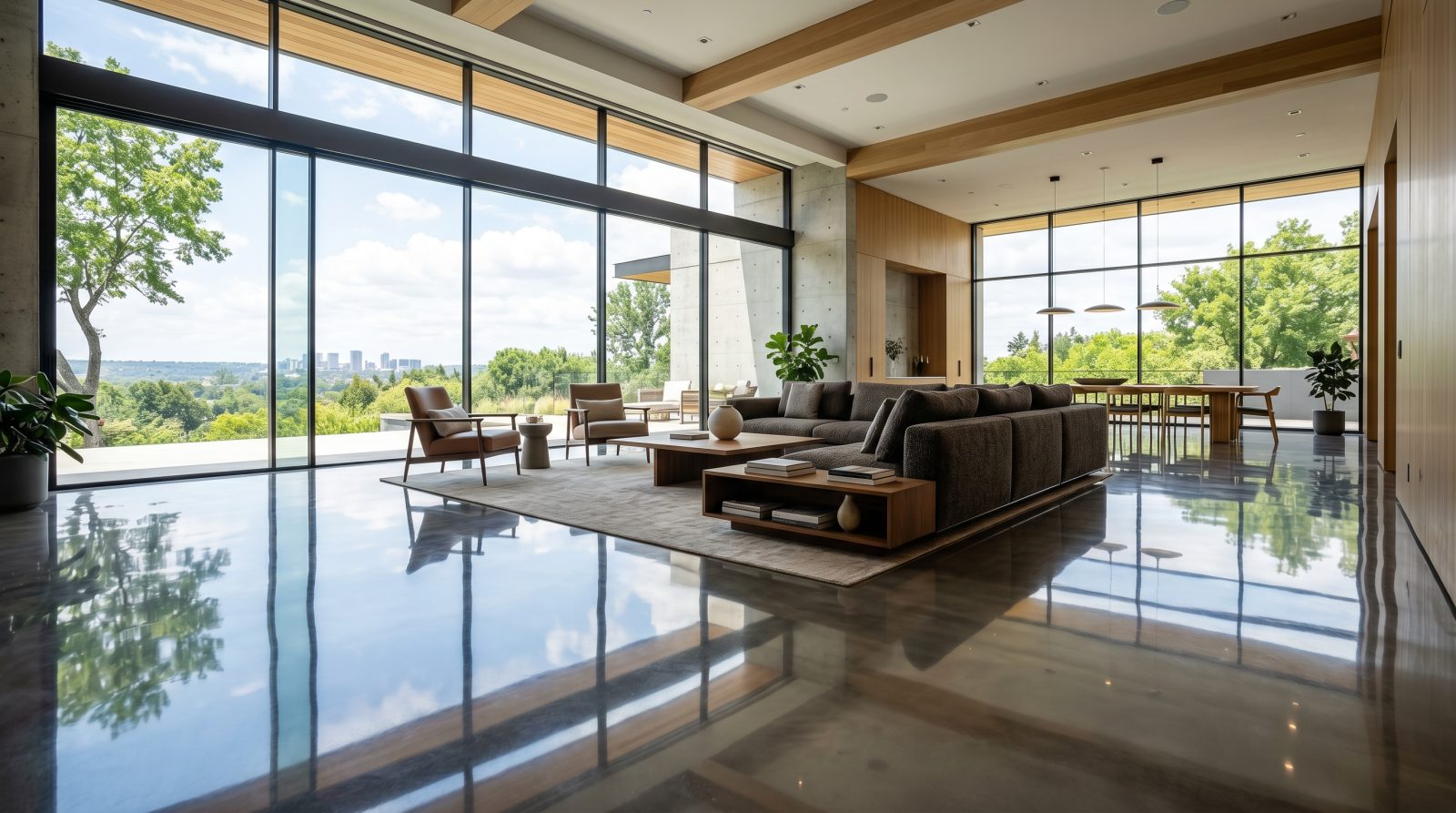
How much does a metallic epoxy floor cost per square foot?
As a general industry estimate, professionally installed metallic epoxy floors fall in the range of roughly $7 to $15 per square foot. Simpler single-color metallic looks on a sound slab land toward the lower end, while multi-color blends, deeper 'lava' or 'marble' effects, and floors that need real surface repair push toward the higher end. These are typical ranges for budgeting and are not a quote for your specific floor.
Square footage is the biggest single driver, but price per foot is not flat. Larger open areas are usually more efficient to coat, so the per-foot cost can ease slightly on a big space, while small or chopped-up rooms with lots of edges and obstacles often cost a bit more per foot because the labor-to-area ratio goes up.
To turn a per-foot range into a budget, measure your space (length times width) and multiply by both ends of the range. That gives you a low-to-high band to plan around before anyone sets foot on your slab.
- Two-car garage (~400-500 sq ft): roughly $3,000-$7,000 (typical estimate)
- Three-car garage (~600-750 sq ft): roughly $4,500-$11,000 (typical estimate)
- Basement or living-area floor (~800-1,200 sq ft): roughly $6,000-$18,000 (typical estimate)
- Small accent area or entryway (under 200 sq ft): often priced with a project minimum
What drives the price up or down?
Two metallic floors of the same size can quote very differently, and almost all of it comes down to the condition of your concrete and the look you want. Understanding these factors helps you read an estimate and know where your dollars are going.
The most expensive part of any quality epoxy floor is rarely the epoxy itself; it's the surface preparation underneath. A floor that skips real prep is the floor that peels in a year, so a fair quote builds in the prep your slab actually needs.
- Surface prep: diamond grinding or shot blasting to open the concrete profile is standard; heavy grinding for old coatings, paint, or sealer adds cost
- Concrete repair: filling cracks, patching spalls, and grinding down high spots all add labor before any coating goes down
- Design complexity: a single metallic color costs less than a multi-color blend with deep movement and custom effects
- Topcoat choice: a higher-grade or extra-durable clear topcoat adds material cost but extends the life of the floor
- Moisture issues: slabs with high moisture may need a moisture-mitigation primer, which is an added line item
- Access and clearing: a garage you've emptied is faster to coat than one we have to work around
Why does metallic epoxy cost more than flake or solid color?
Metallic epoxy almost always prices above a standard flake (chip) floor or a solid-color epoxy, and the difference is real, not a markup. Metallic pigments are a specialized material, and the install is genuinely artistic: the installer moves the metallic resin by hand with rollers, squeegees, and sometimes blowers to create the marbled, three-dimensional movement that makes these floors look like flowing stone or liquid metal.
Because every metallic pour is worked by hand, no two floors come out identical, and the result depends heavily on the installer's skill. That craftsmanship is part of what you're paying for. A flake floor broadcasts color chips over a base coat in a more repeatable, faster process, which is why it typically costs less per square foot.
For comparison and budgeting only: a basic solid-color epoxy often falls in the $3-$7 per square foot range, a flake/chip floor commonly runs $5-$10 per square foot, and metallic systems sit at the top, roughly $7-$15 per square foot. All are typical industry estimates, not quotes, and the right choice depends on the look and durability you want, not just price.
What's included in a professional metallic epoxy quote?
A trustworthy metallic epoxy estimate covers the full system, not just a thin coat of color. When you compare quotes, make sure you're comparing the same scope, because a low number that skips prep or uses a thin build is rarely the bargain it looks like.
A complete professional system generally includes mechanical surface preparation, crack and defect repair, a primer/base coat, the metallic art coat, and one or more clear protective topcoats. The number of topcoats and the quality of the clear are what largely determine how the floor holds up to tires, foot traffic, and dropped tools over the years.
- Mechanical prep: diamond grinding or shot blasting to a proper concrete surface profile
- Repairs: crack filling, patching, and leveling of minor surface defects
- Primer/base coat: bonds the system to the slab and sets the background tone
- Metallic art coat: the hand-worked pigmented layer that creates the look
- Clear topcoat(s): one or more protective layers; more or higher-grade coats add durability and cost
- Optional add-ons: anti-slip additive in the topcoat, moisture-mitigation primer, or a high-wear coat for shops
Metallic epoxy cost in the South Bay: what's specific to here?
Costs in San Jose and the wider South Bay tend to track the higher side of national ranges, mostly because Bay Area labor and overhead run above the national average. The upside is a mild Mediterranean climate that's genuinely friendly to epoxy: epoxy cures best in roughly 60-85°F with moderate humidity, and the South Bay's dry, temperate stretches make it easy to hit good cure conditions for much of the year without the heat or humidity swings that complicate installs elsewhere.
Local slab conditions still matter for the budget. Many South Bay garages and homes sit on older concrete that may have hairline cracks, oil staining, or a previously sealed or painted surface, and each of those adds prep before the metallic coat goes down. Homes near the bay or in lower-lying areas can also carry higher slab moisture, which may call for a moisture-mitigation primer; that's worth checking on an older slab before committing to a number.
Timing is a small lever too. Because cure depends on temperature, we plan installs around the weather: a cool, damp winter week may need extra cure time, while the South Bay's long stretches of mild, dry days are close to ideal. None of this changes the look you get, but it does affect scheduling, and occasionally the prep, on the final estimate.
How to budget and get an accurate number
The fastest way to a realistic budget is to measure your space, apply the per-foot range above, and then expect the real quote to move based on prep. If your slab is in good shape and you want a single metallic color, plan toward the lower-to-middle of the range. If you've got cracks, an old coating to remove, or you want a rich multi-color effect, plan toward the upper end.
Be cautious with any price that sounds far below the typical range; it usually signals skipped surface prep, a thin coat, or a low-grade topcoat, and that's the kind of floor that fails early. A well-installed metallic epoxy floor is a one-time investment that should hold up for years when it's put down right on a properly prepped slab.
When you're ready for a real number instead of a range, give us a call. We'll look at your concrete, talk through the look you want, and put it in writing so you know exactly what you're paying for before any work begins.