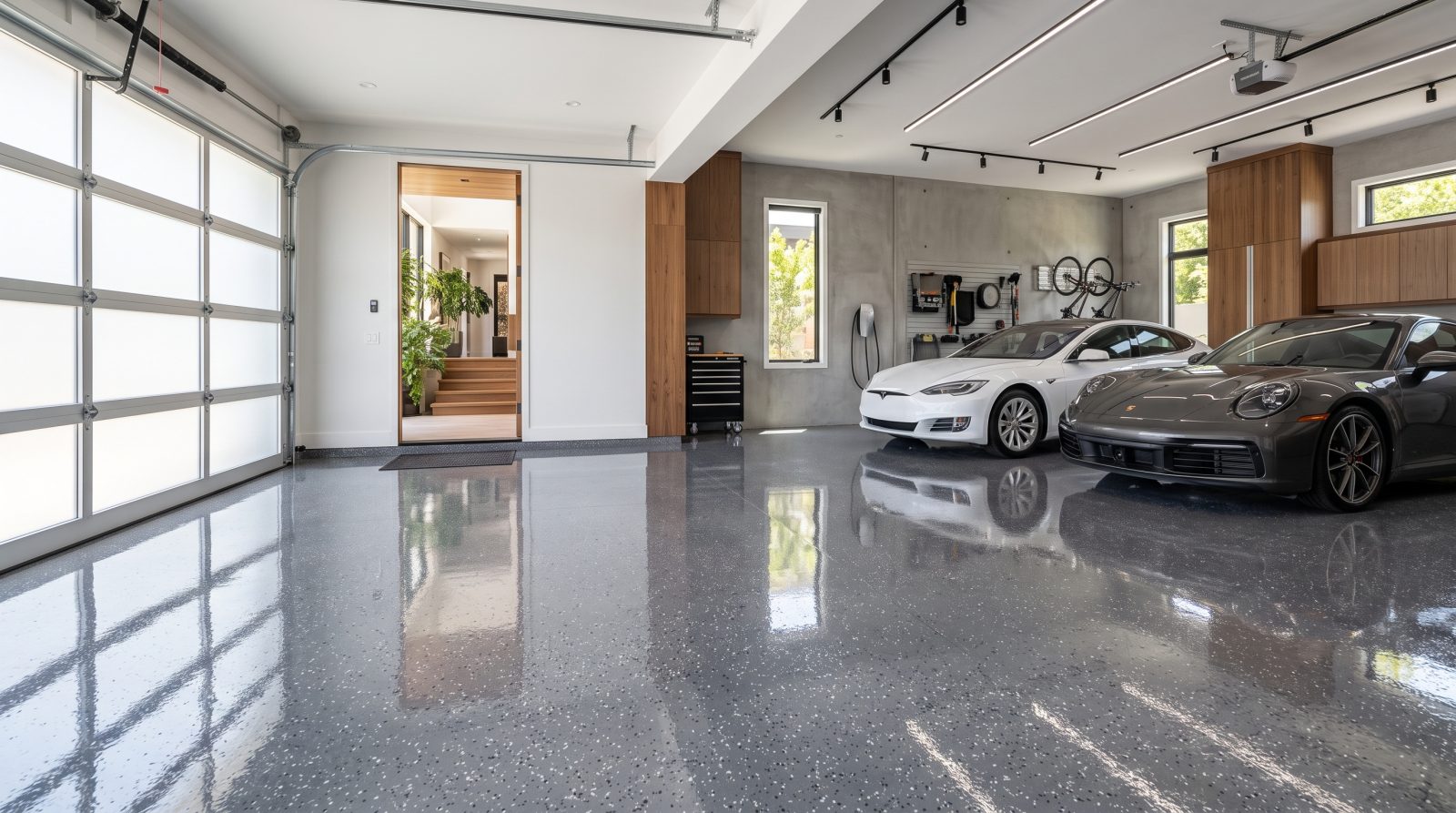
Why Sunnyvale slabs need the right coating
Sunnyvale sits in the heart of Silicon Valley on the valley floor, where homes range from 1950s-60s Eichler and ranch-era tracts near Cherry Chase and the Murphy Avenue area to newer infill and townhome developments closer to Lawrence Expressway and Moffett Park. That spread matters for floor coatings because the age and condition of the slab underneath drive everything. Older Sunnyvale garages often have concrete that has been bare for decades, with absorbed oil, hairline cracks, and a power-troweled surface sealed too tight for a coating to grip without proper grinding. Newer construction may have fresher concrete that still needs to finish curing before it can be coated.
The South Bay climate is generally kind to floor coatings, but it has two quirks worth planning around. First, Sunnyvale gets most of its rain in a concentrated winter window, and during those wetter months a slab on grade can hold more subsurface moisture than it looks like on the surface. Moisture pushing up from below is the single most common reason a coating later peels, so testing for it before installation is not optional. Second, summer afternoons can swing warm, which speeds the cure of fast-set products like polyaspartic; a careful installer adjusts working time and pot life to the day's actual temperature and humidity rather than a fixed recipe.
What we coat in Sunnyvale homes and businesses
Most of our Sunnyvale work is residential garage floors, including the wide two- and three-car garages common in the newer subdivisions and the single- and tandem-bay garages typical of older central Sunnyvale homes. Beyond garages, concrete coatings hold up well on covered patios, walkways, basements and bonus rooms, laundry and utility areas, and the kind of light-commercial spaces you find along Sunnyvale's industrial and tech corridors near Java Drive and the Caltrain corridor.
- Residential garage floors (single, tandem, two-car, and three-car bays)
- Covered patios and outdoor concrete (with UV-stable topcoats so color holds in full sun)
- Workshops, hobby rooms, and home gyms over a garage or basement slab
- Light-commercial and shop floors, breakrooms, and warehouse aisles
- Showroom, retail, and office concrete where a clean, seamless look matters
Epoxy vs. polyaspartic: which fits your Sunnyvale floor?
Both are real concrete coating systems, and the right one depends on your slab, your timeline, and how the floor gets used. Epoxy is a thicker, lower-cost build coat that fills minor imperfections well and creates a hard, chemical-resistant base; standard epoxy can yellow over time under direct sunlight, so it is best as a base coat or for floors out of constant UV. Polyaspartic (a fast-curing polyurea-family coating) is more UV-stable, more abrasion- and chemical-resistant, and cures fast enough to allow same-day or next-day return to service, which is why it is popular as a topcoat over an epoxy base or as part of a flake floor system.
A common, durable approach for a Sunnyvale garage is a multi-coat flake system: a penetrating or epoxy base coat, broadcast vinyl flakes for color and slip resistance, then one or two polyaspartic topcoats. That combination gives you epoxy's build and adhesion plus polyaspartic's speed and sun resistance. For a covered patio that sees afternoon sun, a UV-stable polyaspartic topcoat is the part that keeps the color from fading and chalking.
- Epoxy: thicker build, strong adhesion and chemical resistance, lower cost, can amber in direct UV — ideal as a base coat or for shaded interior floors
- Polyaspartic: UV-stable, fast cure (often walk-on in 24 hours or less), excellent abrasion resistance, higher material cost — ideal as a topcoat and for fast turnarounds
- Flake (chip) system: epoxy base + vinyl flakes + polyaspartic topcoat — a popular all-around garage choice for looks, traction, and longevity
Our process: prep is the whole job
The difference between a coating that lasts a decade and one that peels in a year is almost always surface preparation, not the product. On a Sunnyvale garage we start by clearing and cleaning the slab, then mechanically profiling the concrete — typically diamond grinding (or shot blasting on larger floors) to open the surface so the coating can bond. Acid etching alone is not a substitute for mechanical prep on a dense, troweled garage slab.
Before any coating goes down, we check the concrete for moisture, because a slab on grade in Sunnyvale can wick water up from below, especially after the winter rains. If readings are high, the right move is a moisture-tolerant primer or a different system, not coating over the problem. We then repair cracks and spalls, fill control joints as appropriate, vacuum the surface clean, and apply coats in sequence, respecting each product's recoat window. A realistic timeline: most residential garages are a one- to two-day install, with light foot traffic typically returning in about 24 hours and vehicle traffic usually after roughly 48 to 72 hours, depending on the system and that week's temperature and humidity. We confirm the exact cure schedule for your project before we start.
Typical cost ranges for Sunnyvale floor coatings
The figures below are typical industry estimate ranges for planning only — not a quote. Your actual price depends on slab size and condition, how much crack and spall repair is needed, the coating system you choose, and any moisture mitigation. The honest way to price a floor is to look at it, so we provide a free written estimate after seeing the slab.
As a rough planning guide, basic single-coat epoxy systems tend to fall in the lower end of the range, full flake systems with a polyaspartic topcoat sit in the middle, and floors that need significant repair, moisture mitigation, or metallic and decorative finishes run higher. Square-foot pricing usually drops as the floor gets larger, because mobilization and prep setup are spread over more area.
- Basic epoxy garage floor: a lower-cost per-square-foot range, best for clean, sound slabs out of direct sun
- Full flake system (epoxy base + flakes + polyaspartic topcoat): a mid per-square-foot range for most two- and three-car Sunnyvale garages
- Decorative/metallic or heavy-repair and moisture-mitigation floors: a higher per-square-foot range reflecting added labor and materials
- All ranges are estimates labeled for planning; we provide a free written estimate after inspecting your slab