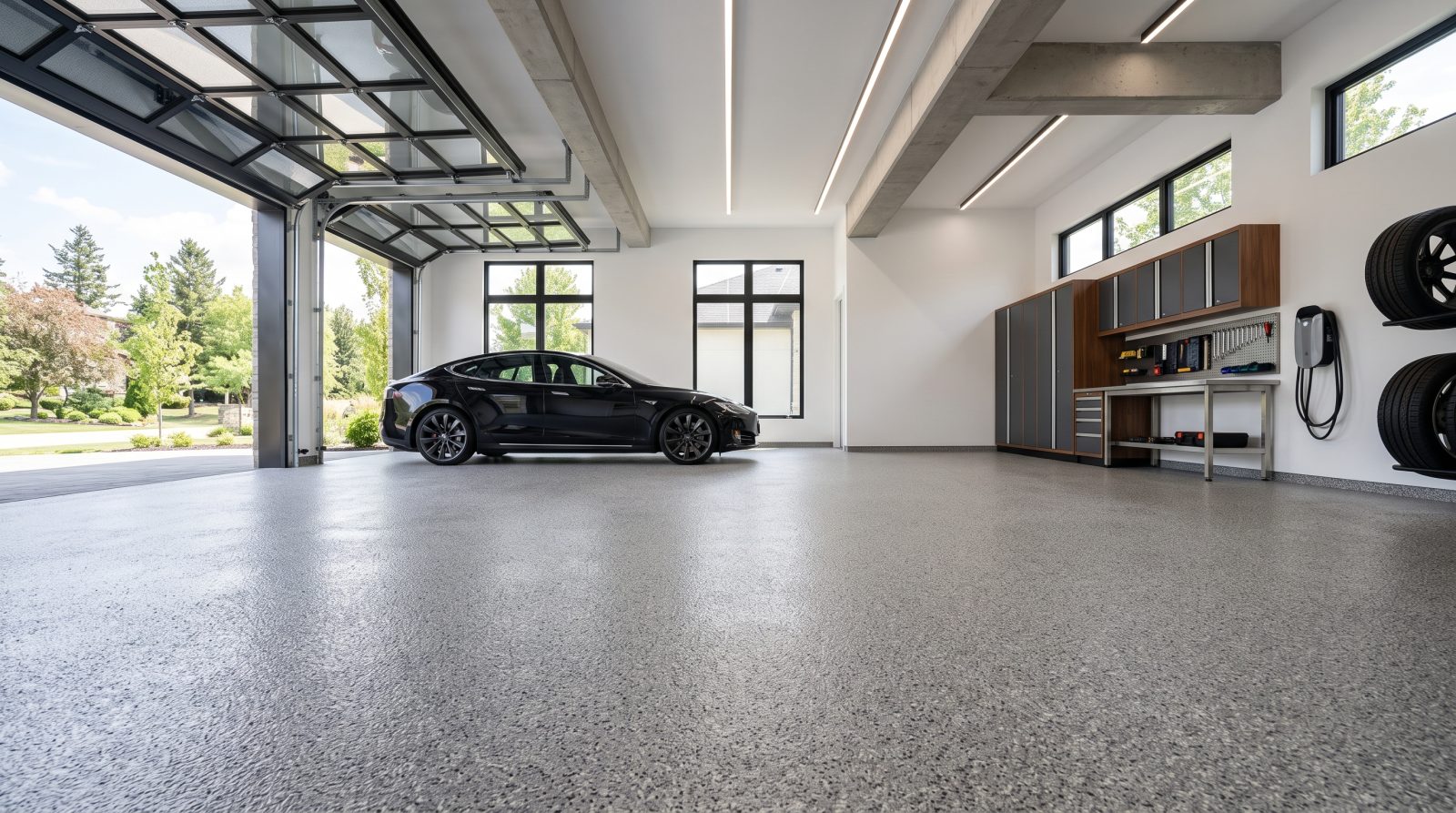
What is an anti-slip floor coating, and how does it work?
An anti-slip (or non-slip) floor coating is a standard resinous coating system — most often epoxy, polyurea, or polyaspartic — finished with a traction additive that creates micro-texture across the surface. When you walk on a sealed concrete floor, the danger isn't the coating itself; it's how smooth and water-repellent that coating becomes. A thin film of water, oil, or even fine dust on a glossy floor acts like a lubricant. The aggregate breaks up that film and gives the sole of your shoe (or a bare foot) something to bite into.
The texture is built in during application, not glued on afterward. The installer broadcasts the aggregate into the wet topcoat, then back-rolls so the media locks into the cured resin. Because it's encapsulated in the coating, it won't sweep away or wash out, and the floor still cleans easily — you're just trading a mirror finish for a fine, sandpaper-like grip.
Slip resistance is commonly described using a coefficient of friction (COF). Smooth, polished coatings can drop into a slick range when wet, while a properly textured anti-slip finish is designed to hold traction in wet conditions. The exact feel is adjustable: a light additive gives a subtle grip that's still comfortable for bare feet, while a heavier broadcast creates an aggressive, boot-grade texture for shops and ramps.
Which traction additive is right for your floor?
There's no single 'non-slip' product — the right additive depends on the room, the footwear, and how the floor gets cleaned. Choosing well is the difference between a floor that's genuinely safer and one that's either still too slick or so rough it's hard to mop and uncomfortable underfoot.
We match the aggregate to how the space is actually used. A barefoot pool deck and a forklift ramp both need slip resistance, but they call for very different textures.
- Aluminum oxide — extremely hard and durable; the workhorse for garages, ramps, and industrial floors that see vehicle traffic and abrasion. Most aggressive grip, but rougher on bare feet.
- Polymer / plastic grit — a softer, lower-profile texture that's comfortable for bare feet and easy to clean; well suited to entries, laundry rooms, and indoor living spaces.
- Graded silica sand — an economical, adjustable option broadcast to the texture you want; common in shop and utility-area floors.
- Micronized polymer beads — a near-invisible fine texture for areas where you want grip without changing the floor's look or feel much.
- Texture additives mixed into the topcoat — for slip resistance with the smoothest possible surface where heavy traction isn't required.
Where anti-slip coatings matter most
Any concrete floor that gets wet, oily, or sees foot traffic in changing conditions is a candidate. The most common problem we're called for is a garage or patio that was coated for looks and turned into a skating rink the first time it rained or a car dripped on it — and in the South Bay's damp, foggy mornings, that slick film shows up far more often than people plan for.
Slip resistance is especially worth specifying upfront in these spaces:
- Garages — where tires track in rain and road film, and where oil and coolant drips collect under vehicles.
- Patios, walkways, and pool surrounds — exposed to rain, sprinklers, and splash, often used barefoot.
- Entryways and mudrooms — the transition zone where wet shoes meet a hard floor.
- Laundry rooms, utility rooms, and water-heater closets — where leaks and condensation are routine.
- Workshops, commercial kitchens, and wash bays — where standing water, oils, and detergents are part of the job.
- Ramps and sloped surfaces — where any moisture plus an incline multiplies slip risk.
How we install an anti-slip floor coating
A non-slip floor is only as good as the prep and the application. The traction additive does its job only if the coating underneath bonds permanently to the concrete — so the bulk of the work, and the bulk of the value, is in the steps you never see in the finished floor.
Our typical process for an anti-slip coating follows these stages:
- Inspect and test the slab — check for existing coatings, cracks, oil saturation, and moisture, since concrete that's pushing moisture vapor can fail a coating no matter how well it's applied.
- Mechanically profile the concrete — we diamond-grind (or shot-blast) the surface to open the pores so the coating can key in. Acid-etching alone is not a substitute for mechanical prep on most floors.
- Repair and fill — grind out and patch cracks, spalls, and pitting so the finished surface is sound.
- Apply the base/build coats — lay down the primer and body coats appropriate to the system (epoxy, polyurea, or polyaspartic).
- Broadcast the traction aggregate — distribute the chosen additive into the wet topcoat at the texture level you've selected, then back-roll to lock it in.
- Seal with the final topcoat — encapsulate the aggregate so it stays put and the floor stays cleanable.
Cure times, thickness, and the practical details
These are general industry figures for resinous floor systems so you know what to expect — they're not a quote, and the exact numbers depend on the product line, film thickness, and conditions on your slab.
Cure time is the detail that surprises most homeowners. The floor can usually be walked on within roughly 12–24 hours, but it typically needs around 24–72 hours before vehicle traffic, and full chemical cure can take up to about 7 days. Polyaspartic and polyurea systems cure substantially faster than traditional epoxy — often returning a garage to service in about a day — which is part of why they're popular for fast turnarounds.
Temperature and humidity matter during application and cure. Most coatings want a slab and ambient temperature in a moderate range (roughly 50–85°F) and benefit from controlled humidity; very cold, very hot, or damp conditions can affect bond, cure speed, and finish. In coastal South Bay microclimates, morning fog and concrete that holds moisture are real variables a good installer schedules around.
Film thickness is described in mils (thousandths of an inch). A thin roll-on topcoat is on the order of a few mils, while a full broadcast system builds up meaningfully thicker — and thickness, plus the grade of aggregate, is what determines both durability and how aggressive the texture feels.
What does anti-slip floor coating cost?
Pricing is best given after we see the slab, because the floor's current condition drives most of the cost — but here are typical industry ranges so you can budget. These are estimates, not quotes, and your actual price depends on square footage, prep needs, the coating system, and the texture level.
For most residential projects, professionally installed resinous floor coatings commonly fall somewhere in the range of about $3 to $12 or more per square foot installed. Simpler single-color systems on sound concrete land toward the lower end; full broadcast systems, heavy repair work, multiple coats, or premium polyaspartic systems push toward the higher end. Adding anti-slip aggregate itself is a modest incremental cost on top of the base system.
The biggest swing factor is prep. A clean, sound slab is straightforward; a floor with oil saturation, an old failing coating to remove, moisture issues, or significant cracking takes more labor before any coating goes down. That's why a smaller, well-prepped floor can cost more per square foot than a larger one in good shape — and why an in-person look is the only way to give you a real number.
Ready for a floor you can trust when it's wet?
If you've got a garage, patio, or wet-area floor that's slick when it counts — or you're planning a new coating and want to build slip resistance in from the start — we can walk the space, test the slab, and recommend the right traction level for how you actually use the room. We'll explain the system, the prep, the realistic timeline, and a clear estimate.
Reach out to talk through your floor and schedule a look. We serve homeowners and businesses across the South Bay, and we'll give you straight, plain-English answers — no pressure, no hype.