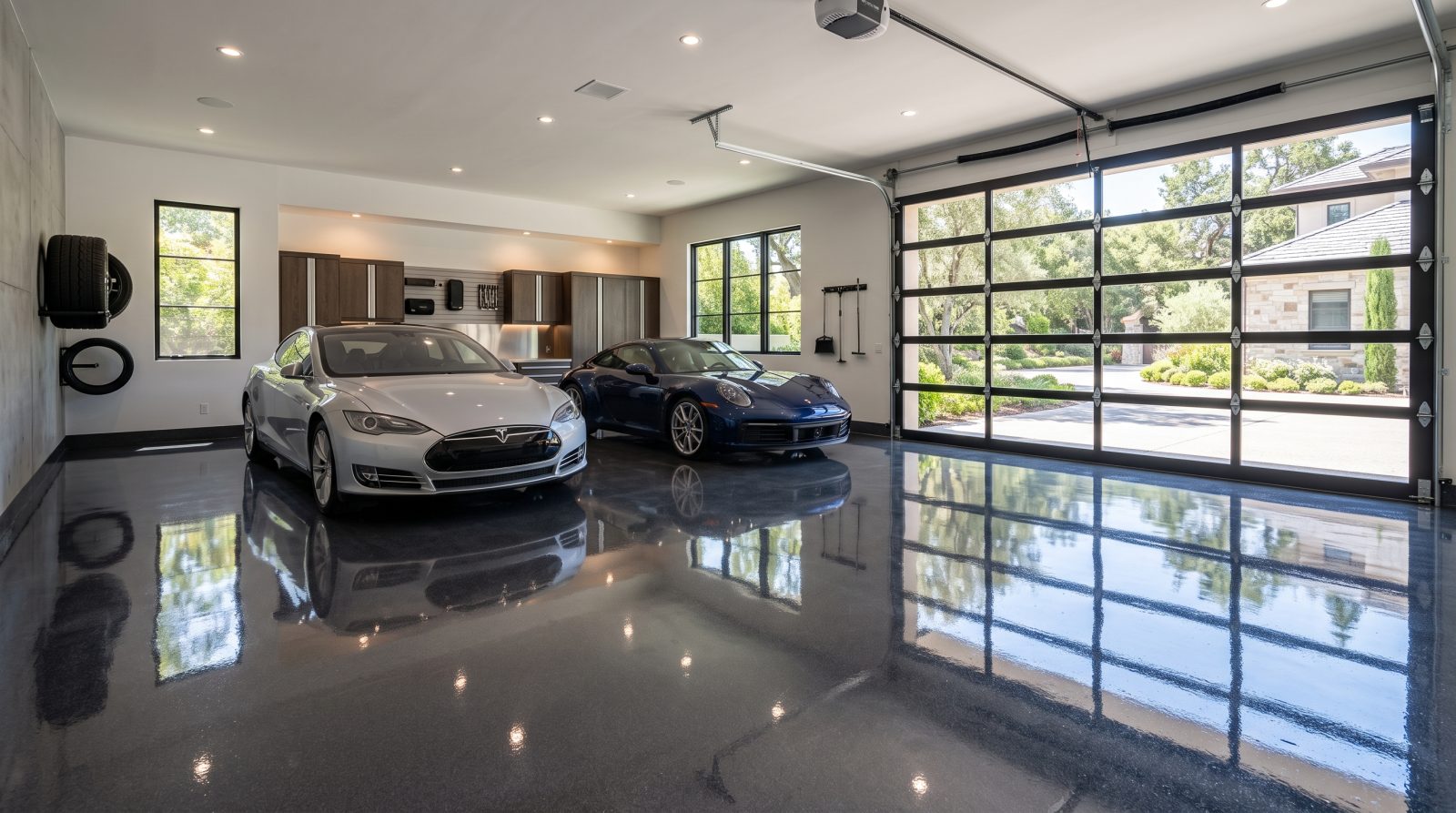
Why Saratoga's foothill conditions shape a floor coating
Saratoga sits at the base of the Santa Cruz Mountains in the West Valley, and its ground behaves differently from the flatter parts of the South Bay. Much of the town rests on expansive clay that swells when winter rain soaks in and shrinks when summer dries it out. That seasonal movement is a leading reason garage and patio slabs here develop hairline cracks, lifted joints, and surface spalling over time. A coating doesn't stop the soil from moving, but a properly prepped and patched slab gives the coating a stable, sound surface to bond to, so it flexes and wears as one system instead of peeling.
The climate adds a second factor. Saratoga follows a Mediterranean pattern of hot, dry summers and cool, wet winters, with marine fog that rolls up from the valley on many mornings. Under the town's heavy oak and redwood canopy, slabs in shaded side yards and north-facing garages stay damp longer and dry slower. That trapped moisture is what can lift a coating installed without a moisture test, which is why we check for vapor drive before we coat so the system is matched to the slab rather than rolled on and hoped for.
Because so many Saratoga homes are older custom builds and estates on sloped or hillside lots, no two slabs are the same age, mix, or condition. We treat each floor on its own terms instead of applying one product to everything.
What we coat on Saratoga homes
The most common request in Saratoga is the garage floor, and many of those garages are detached or side-entry structures on the larger lots common in the foothills. Garage coatings take the brunt of tire heat, dropped tools, oil, and the grit tracked in from gravel and unpaved hillside driveways, so a durable surface that wipes clean is a practical upgrade, not just a cosmetic one.
Beyond the garage, we coat back patios and covered outdoor areas, basement and lower-level slabs in hillside homes, sunroom and bonus-room floors, workshop and hobby-shop floors, and equipment or storage areas. Each space gets a system chosen for how it's used and how much sun and moisture it sees.
- Attached and detached garage floors
- Covered patios and outdoor entertaining areas
- Basement and hillside lower-level slabs
- Workshops, hobby shops, and storage rooms
- Sunrooms, bonus rooms, and laundry areas
Epoxy vs. polyaspartic: which fits a Saratoga floor?
Epoxy and polyaspartic are both worth considering, and the right pick depends on the slab and how the space is used. Epoxy builds a thick, hard film and is a strong value for interior garage floors that stay relatively dry. A full system is typically built up to roughly 8 to 20 mils or more depending on the number of coats and any flake, giving a tough, chemical-resistant surface.
Polyaspartic, a polyurea-based topcoat, cures faster and holds its color better under UV, which matters for the patios and sun-exposed bays on Saratoga's open, south-facing lots. It also stays more flexible through temperature swings, an advantage when a foothill garage can be cold and foggy in the morning and warm by afternoon. Many of our installs use a hybrid: an epoxy base coat for build and bond, finished with a polyaspartic topcoat for UV stability and a faster return to service. Because polyaspartic tolerates a wider temperature and humidity window during install, it's often the better choice for damp shaded slabs and for getting a vehicle back in sooner.
- Epoxy: thick build, hard wearing, strong value for dry interior garages
- Polyaspartic: better UV color hold, fast cure, flexible through temperature swings
- Hybrid epoxy + polyaspartic: build and bond plus a tough, sun-resistant finish
- UV color retention matters on Saratoga's sunny, open patios
- Faster cure helps when you need the garage back quickly
Our prep process: where coating life is won or lost
On a Saratoga slab, surface prep is most of the job. We start by moisture-testing the concrete, which matters here given the marine fog, shaded canopy, and older slabs that may lack a proper vapor barrier underneath. If the slab shows high vapor drive, we address it before any product goes down rather than coating over a problem.
Next we mechanically profile the surface, typically by diamond grinding or shot blasting, to open the concrete's pores so the coating bonds into the slab instead of sitting on top of a sealed or contaminated surface. We then patch the cracks and spalls that clay movement tends to create, fill control joints as needed, and clean the floor thoroughly. Coatings are applied within the manufacturer's temperature and humidity range, which on a cool, foggy Saratoga morning can mean timing the work for the right part of the day. Typical cure times run roughly 12 to 24 hours for foot traffic and a few days before heavy vehicle traffic, depending on the product and conditions, with polyaspartic systems returning to service faster. We confirm the actual windows for your specific install.
Typical cost ranges in the Saratoga area
Across the South Bay, professionally installed garage floor coatings commonly fall in a range of about $4 to $12 or more per square foot, which means a standard two-car garage often lands somewhere in the low-to-mid four figures. These are typical industry ranges shown as planning estimates, not a quote, and your real number depends on the slab.
What moves the price on a Saratoga floor: how much crack and spall repair the clay-driven movement has caused, whether moisture mitigation is needed, the system chosen (a flake epoxy versus a full polyaspartic or metallic finish), the square footage and number of bays, and access on a sloped or hillside lot. We provide a written estimate after we see and test the actual concrete, because guessing at a slab we haven't inspected wouldn't be fair to you. Call us to set up a free on-site estimate.