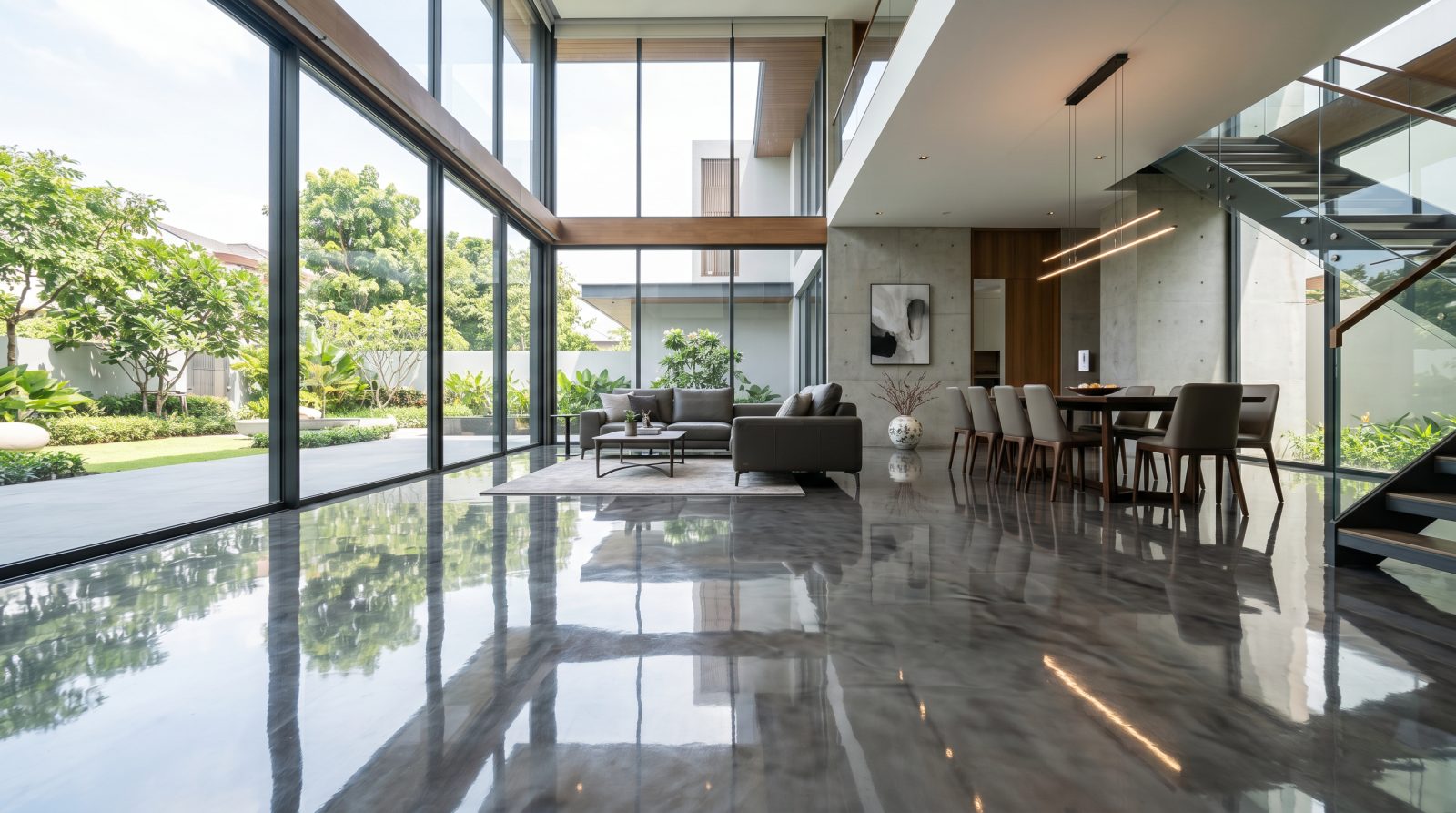
What's actually the difference between epoxy and polyaspartic?
Both are two-part coatings: you mix a resin with a hardener, and a chemical reaction turns a liquid into a solid film bonded to your concrete. The difference is in the chemistry and how that reaction behaves.
Epoxy is built from epoxide resins and an amine hardener. It tends to go on thick, self-levels nicely, and forms a hard, glossy film with a strong mechanical and chemical bond to properly prepared concrete. The trade-off is time: standard epoxy can take 12 to 24 hours before you can walk on it and several days before it's fully cured and ready for vehicle traffic.
Polyaspartic is a type of polyurea, a fast-reacting aliphatic coating. 'Aliphatic' is the key word for floors that see daylight: it's the chemistry that gives polyaspartic its strong UV and color stability. It cures dramatically faster than epoxy and stays slightly flexible, which helps it handle the daily expansion and contraction of a concrete slab without cracking.
A practical way to think about it: epoxy is the dependable, lower-cost foundation, and polyaspartic is the tougher, faster, more weather-stable finish. They are often layered together rather than chosen one-or-the-other.
- Epoxy: epoxide resin + amine hardener; thick, glossy, strong adhesion, slow cure
- Polyaspartic: aliphatic polyurea; fast cure, UV-stable, abrasion-resistant, flexible
- Both require the same critical step to last: thorough concrete prep
- Many quality systems use an epoxy or polyurea base coat under a polyaspartic topcoat
How long does each take to cure and walk on?
Cure time is the single biggest day-to-day difference, and it's the first thing most homeowners ask about.
Epoxy typically needs about 12 to 24 hours before light foot traffic and roughly 3 to 7 days before you should park a vehicle on it or set down heavy items. Full chemical cure, where the coating reaches its maximum hardness and chemical resistance, can take up to a week or more depending on temperature and humidity. In cooler conditions, epoxy cures more slowly; below roughly 50 to 55 degrees Fahrenheit it can struggle to cure properly at all.
Polyaspartic is the fast lane. Many polyaspartic topcoats are walkable in about 2 to 4 hours and ready for vehicle traffic in roughly 24 hours. Some formulations are engineered for same-day-return projects. Polyaspartic also cures across a wider temperature range, which is part of why it's favored when a job needs to be done quickly or in less-than-ideal weather.
The flip side of polyaspartic's speed is a short working window, sometimes only 10 to 20 minutes of 'pot life' once it's mixed. That's a real reason this material rewards experienced application: there's little room to fix a mistake before it sets.
- Epoxy: ~12-24 hrs to walk on; ~3-7 days before parking a car
- Polyaspartic: often ~2-4 hrs to walk on; ~24 hrs before vehicle traffic
- Epoxy prefers warmer installs (roughly 50-90F); polyaspartic tolerates a wider range
- Polyaspartic's short pot life is why even, professional application matters
Which one lasts longer and handles wear better?
Durability depends less on the brand name and more on three things: surface prep, total coating thickness (measured in mils, where one mil is a thousandth of an inch), and the topcoat chemistry that takes the daily beating.
Epoxy is genuinely hard and chemically resistant, which makes it strong against oil, many solvents, and abrasion. Its weak points are UV light and impact. Standard epoxy exposed to direct sunlight, like near an open garage door or a sunlit window, can amber or yellow over time. It can also chip or delaminate if a heavy object is dropped or if it was applied over concrete that wasn't properly prepped or had moisture issues.
Polyaspartic generally outperforms epoxy on scratch and abrasion resistance, stays color-stable under UV, and resists hot-tire pickup, the phenomenon where warm tires can lift a coating off the floor. Its slight flexibility also helps it ride out the slab's seasonal movement instead of cracking.
This is why the layered approach holds up so well for longevity: an epoxy or polyurea base maximizes adhesion to the concrete, and a polyaspartic topcoat takes the wear, the sunlight, and the tire heat. A well-prepped, properly layered floor commonly carries a long service life, but any honest contractor will tell you the prep underneath matters more than the marketing on the bucket.
- Epoxy: strong chemical/abrasion resistance; vulnerable to UV yellowing and impact chips
- Polyaspartic: better scratch, UV, and hot-tire-pickup resistance; stays flexible
- Total thickness in mils and the topcoat do most of the long-term work
- Prep quality is the real predictor of how long any coating lasts
What does each typically cost?
These are typical industry estimate ranges, not a quote. Your real number depends on slab condition, square footage, how much repair and prep the concrete needs, the system you choose, and finish details like flake or a topcoat.
Epoxy-only systems are generally the most budget-friendly resin option, often landing in the lower end of professionally installed coating ranges. A full polyaspartic system, or a hybrid epoxy-base-with-polyaspartic-topcoat system, typically costs more, reflecting the faster material, the higher-performance topcoat, and the skill required to install it well within its short working window.
It's worth weighing the install cost against the lifetime cost. A cheaper epoxy-only floor that yellows or needs recoating sooner can cost more over ten years than a hybrid system installed once. On the other hand, if a floor lives in a shaded interior space and budget is tight, a quality epoxy can be a sensible, honest choice.
The single biggest hidden cost on any job is concrete repair and prep. Cracks, pitting, oil saturation, and moisture all add labor before a single coat goes down, and skipping that step is the most common reason a coating fails early. Any estimate should be based on someone actually looking at your slab, not a flat per-foot guess over the phone.
- Epoxy-only: usually the lower-cost professionally installed resin option
- Polyaspartic / hybrid systems: typically cost more for faster, tougher, UV-stable results
- Prep and concrete repair are the biggest variables in any real number
- Ranges here are estimates; a true price requires an on-site look at your floor
Why proper concrete prep decides everything
Neither epoxy nor polyaspartic bonds to a smooth, sealed, or dirty slab. The coating is only as good as its grip on the concrete, and that grip is created by prep, not by the resin.
Quality prep usually starts with mechanical profiling, either diamond grinding or shot blasting, to open the concrete's pores and create a slightly textured surface (often described against the CSP, or Concrete Surface Profile, scale) that the coating can lock into. Acid etching alone is generally considered inferior to grinding for a long-lasting result. Cracks and spalls are then repaired, oil contamination is addressed, and the floor is cleaned of all dust before any coating goes down.
Moisture is the quiet killer. Concrete on grade can wick water vapor up from the soil, and if that vapor gets trapped under a coating it causes bubbling and delamination. A moisture test before coating, and a moisture-tolerant primer when needed, is the kind of step that separates a floor that lasts from one that peels in a year.
Temperature and humidity at install time matter too. Both coatings have a recommended application window, and a careful installer checks slab temperature, air temperature, and dew point before mixing anything, because applying near the dew point can trap moisture in the film.
- Diamond grinding or shot blasting beats acid etching for lasting adhesion
- Crack repair, oil removal, and full dust removal happen before coating
- A moisture test prevents the bubbling and peeling that ruins coatings early
- Slab temp, air temp, and dew point are checked before any product is mixed
So which should you choose?
There's no universally right coating, only the right fit for your slab, your space, and your priorities. Here's an honest decision framework.
Lean toward epoxy if your floor is in a shaded interior space with little direct sunlight, budget is the top priority, and you can give the floor several days to cure before heavy use. Epoxy delivers a hard, glossy, chemically resistant surface at a friendlier price.
Lean toward polyaspartic, or a hybrid system, if your floor gets direct sun, you want the fastest possible return to use, you're concerned about hot-tire pickup or scratching, or you simply want the longest-lasting finish and color stability. The garage that bakes in afternoon sun through an open door is a classic case where polyaspartic's UV stability earns its higher cost.
South Bay garages face a specific combination: strong, year-round sun that drives UV yellowing and hot-tire pickup, plus a mild climate that makes people want to actually use the garage as a workshop or gym all year. For that mix, a layered system, an epoxy or polyurea base under a polyaspartic topcoat, tends to be the best balance of price, durability, and speed. The right call still depends on what your concrete actually needs, which is why we recommend an on-site assessment rather than guessing from a brochure. Call us and we'll walk your floor with you and explain the honest trade-offs for your specific slab.
- Choose epoxy: shaded interior, tight budget, time to cure
- Choose polyaspartic: sun exposure, fast return to use, maximum durability
- Choose a hybrid: best all-around balance for most sunlit South Bay garages
- Best next step: an on-site look at your slab before any product is chosen