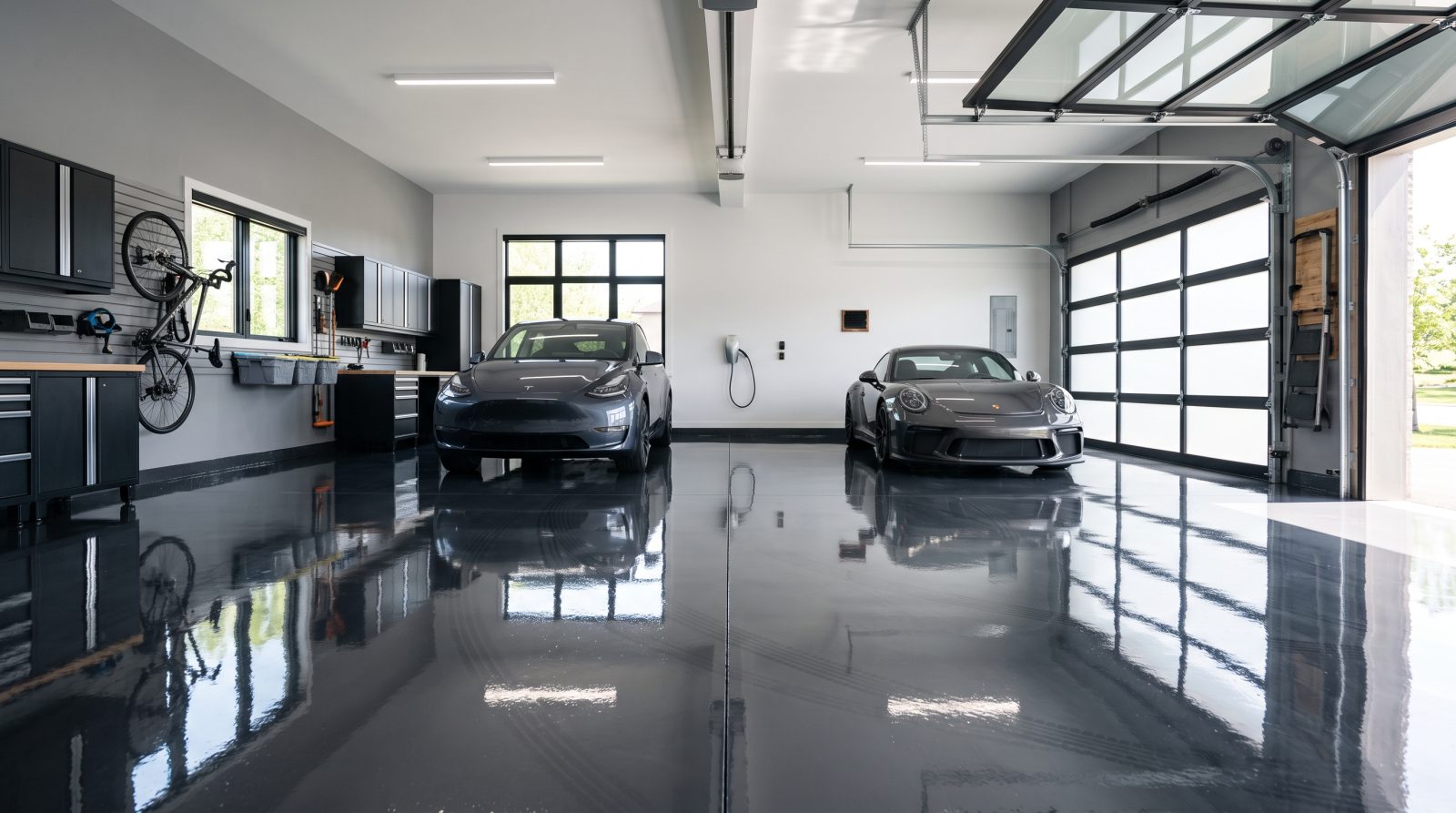
What is garage floor epoxy and how is it different from paint?
Garage floor epoxy is a two-part system: a resin and a hardener that are mixed on site and chemically cure into a rigid, plastic-like layer bonded to the concrete. Standard one-part "garage floor paint" sold in cans dries by evaporation and sits on top of the slab, so it tends to peel, chip, and lift under hot tires within a season or two. A true epoxy or polyaspartic system cures into the surface and is built to take vehicle traffic.
The biggest practical difference is adhesion. Epoxy only performs as well as the prep underneath it, which is why a professional system almost always begins with diamond grinding or shot blasting rather than simply cleaning and rolling. That mechanical profile is what gives the resin something to grip. Skipping it is the single most common reason DIY garage coatings fail.
Many quality installations are technically a hybrid: an epoxy base coat for build and adhesion, a broadcast of decorative vinyl flakes, and a polyaspartic or polyurethane clear topcoat for UV stability and faster return-to-service. People still call the whole thing "epoxy," but the topcoat is doing a lot of the protective work.
- Epoxy = two-part resin that chemically cures and bonds into the slab
- Garage floor paint = single-part coating that dries on top and peels under hot tires
- Professional systems are typically 20–40 mils thick versus a few mils for paint
- A flake-and-topcoat system adds grip, UV stability, and hides minor slab flaws
What does the installation process look like, step by step?
A professional garage floor epoxy job is mostly prep. The coating itself goes down quickly; getting the concrete ready is where the durability is won or lost. Here is the typical sequence for a residential garage.
First, the garage is cleared and the slab is cleaned and degreased. Next comes mechanical profiling, usually diamond grinding, to remove old coatings and sealers and open the concrete pores. Cracks, pits, and control joints are then patched and filled with a compatible repair compound. A moisture test is run, because excess vapor coming up through the slab can push a coating off later. Once the surface is sound and dry, a primer or base coat is applied, decorative flakes are broadcast (if chosen), any excess flake is scraped and the floor is lightly re-sanded, and finally one or two clear topcoats seal everything in.
Temperature and humidity matter throughout. Most epoxies want a slab surface above roughly 50–55°F and want the concrete to be at least 5°F above the dew point during application, so a damp or cold garage can stall the work. The South Bay's mild, generally dry inland weather is usually cooperative, but the coastal marine layer that rolls in toward Redondo, Hermosa, and the bayfront can leave mornings humid, so a good installer checks conditions on the day rather than assuming.
- Clear, clean, and degrease the slab
- Diamond grind or shot blast to profile the concrete
- Patch cracks, pits, and joints with compatible filler
- Run a moisture test before any resin goes down
- Apply primer/base coat, broadcast flakes, then clear topcoat(s)
How long does it take and when can I park on it?
For a typical one- or two-car South Bay garage, the installation is often completed in one to two days, depending on slab condition, how much crack and pitting repair is needed, and which coating system is used. The bulk of the calendar time is cure time, not labor.
Cure times depend on the chemistry and the temperature. As general industry guidance: you can usually walk on a standard epoxy floor after about 12–24 hours, and it's typically ready for vehicle traffic after roughly 3–7 days for traditional epoxy systems. Faster polyaspartic topcoats can shorten this considerably, sometimes allowing foot traffic the same day and cars within about 24 hours. Your installer should give you specific times for the exact product used, since these are ranges that shift with conditions.
Resisting the urge to park early matters. Driving on a coating before it has fully cross-linked can leave tire impressions or pull the finish, and that's avoidable damage. Plan for a few days without the garage, and don't drag heavy objects across a freshly coated floor.
- Installation: often 1–2 days for a standard residential garage
- Light foot traffic: typically ~12–24 hours for standard epoxy
- Vehicle traffic: roughly 3–7 days for traditional epoxy; faster with polyaspartic
- Cure times are temperature-dependent estimates, not fixed promises
What finishes and options can I choose?
The look of a garage floor coating is highly customizable, which is part of why homeowners choose it over bare concrete. The most popular residential choice is a full decorative flake (also called chip) system, where colored vinyl flakes are broadcast into the base coat. Flakes add visual depth, hide minor slab imperfections, and create natural slip resistance under the topcoat.
Beyond flake, you can choose solid-color epoxy for a clean, uniform look, or metallic epoxy for a marbled, three-dimensional effect that reads more like a showroom or living space than a garage. Each has trade-offs: solid colors show dust and tire marks more readily, while metallics look striking but require more skill to install consistently.
Slip resistance is worth a conversation, especially in a garage that gets wet from rain runoff or car washing. Flake systems already provide some texture, and an anti-slip additive can be mixed into the topcoat for extra grip. There's a balance, though: more aggressive texture grabs more dirt and is harder to mop, so the right amount depends on how you use the space.
- Decorative flake/chip: most popular; hides flaws and adds grip
- Solid color: clean and uniform, but shows dust and tire marks more
- Metallic epoxy: marbled, high-end look that demands skilled installation
- Anti-slip additive in the topcoat for wet or sloped garages
What does garage floor epoxy typically cost?
Pricing for garage floor epoxy is usually quoted per square foot, and the range is wide because the system and the slab condition drive the number. As a typical industry estimate, professional coatings often fall somewhere around $3 to $12 per square foot, with premium metallic or heavy-duty polyaspartic systems running higher. These are general ranges to set expectations, not a quote for your specific floor.
For context, a standard two-car garage is roughly 400–600 square feet, so the same per-foot range can produce very different project totals depending on size. The other big variables are how much grinding, crack repair, and old-coating removal the slab needs, and which topcoat you select. A floor with significant pitting, oil staining, or a failing previous coating takes more prep, and prep is labor.
It's worth being skeptical of a price that seems unusually low. A bargain number often signals a thin, one-coat product or skipped grinding, both of which shorten the life of the floor. We're happy to walk through what's included in an estimate so you can compare offers on equal footing rather than on headline price alone. To talk through your specific garage, give us a call and we can explain what would drive the cost up or down.
- Typical industry range: roughly $3–$12 per square foot, premium systems higher
- A two-car garage is commonly ~400–600 sq ft
- Slab condition (cracks, pitting, old coatings) is a major cost driver
- Suspiciously cheap quotes often mean thin product or skipped surface prep
Is epoxy a good fit for South Bay garages?
The South Bay's mild, generally dry climate is friendly to epoxy. Application is easier when temperatures are moderate and the slab is dry, which holds for much of the year here, and the relatively low humidity inland helps coatings cure cleanly. That said, garages closer to the coast in places like Manhattan Beach, Hermosa, or Redondo, or any garage with poor drainage, can carry more slab moisture than they look, which is exactly why a moisture test before coating is non-negotiable.
Many South Bay homes sit on garage slabs poured decades ago, and older concrete often comes with hairline cracking, control-joint movement, or a previously applied sealer that has to be ground off. None of that rules out epoxy; it just means the prep step is where the attention goes. A coating applied over an old, slick sealer without grinding will not hold, no matter how good the resin is.
Direct sunlight through an open garage door can also yellow some pure epoxies over time, and many South Bay garages take strong afternoon sun off the water. If your door faces that exposure, a UV-stable polyaspartic or polyurethane topcoat is the better call. If you're weighing whether your particular slab and garage are good candidates, call us and we can talk through what to check before committing to a coating.
- Mild, dry South Bay conditions generally favor clean application and cure
- Older garage slabs may need extra crack repair and old-sealer removal
- Coastal or poorly drained garages make a moisture test essential
- UV-stable topcoats help when the open door faces strong afternoon sun